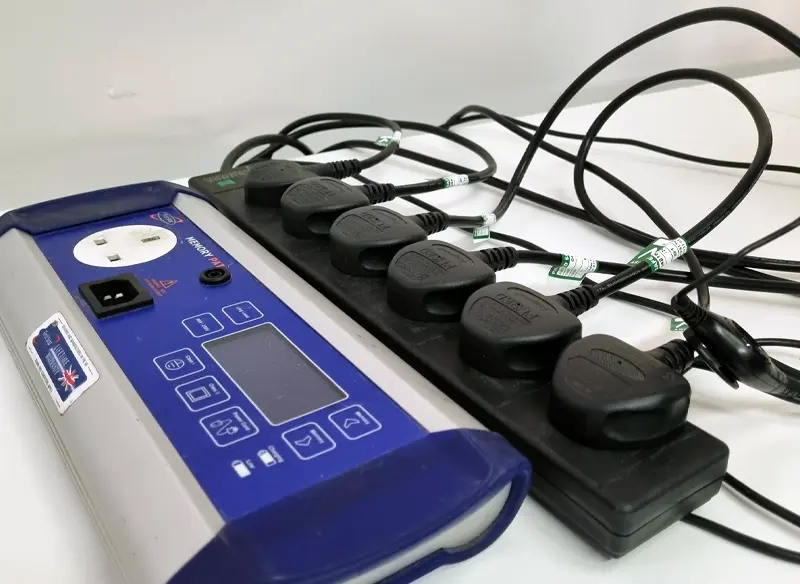
Portable Appliance Testing in Coventry
Fast, Reliable Portable Appliance Testing in Coventry
Maintaining electrical appliance safety often involves portable appliance testing for businesses, organisations, schools and landlords across Coventry to ensure electrical appliances are safe for everyday use.
The process of PAT testing involves:
- Visual inspections of casings, cables, and plugs.
- Using an electrical PAT tester to check for insulation resistance, earth continuity, and to verify polarity.
- Issuing a PAT test certificate, as applicable, to record the results from each test.
Portable appliance testing is widely used in commercial premises, schools, healthcare environments and rental properties. Landlords are responsible for ensuring that all electrical equipment made available to tenants is safe to use and tested on a regular basis.
PAT testing includes a initial visit charge starting from £80 for up to 40 appliances. As the number of appliances increases, the cost per appliance reduces, so clients with higher volumes of equipment are welcome to request a bespoke quote. Portable appliance testing must always be performed by a qualified and competent technician holding a recognised national qualification such as City & Guilds 2377-22.
Trusted Portable Appliance Testing for Commercial Premises
Workplace electrical safety is a legal responsibility, designed to safeguard your staff, assets and day-to-day operations.
We provide professional PAT testing across Coventry and nearby areas. Our experienced PAT engineers inspect and test your portable electrical equipment to ensure it meets current health and safety requirements.
We provide a professional report outlining the results of our equipment inspection, while minimising disruption to your normal operations. We work systematically and in compliance with current health and safety regulations to ensure your business continues to comply with all applicable health and safety legislation.
Regular PAT testing is an reliable way to minimise the risk of electrical accidents and demonstrate to your employees, clients and regulatory bodies that you have taken the appropriate measures to provide and maintain a safe working environment.
Price List
Our Pricing
The more appliances you have, the greater the savings.
There is a call out fee of £80, which covers you for the first 40 appliances, then depending on total amount, prices vary - check out the table below for an easy to understand pricing table.
What Does PAT Testing Involve?
PAT testing is the examination and testing of mains-powered electrical equipment to ensure that the equipment does not pose a risk of electric shock or additional electrical hazards to people using the equipment.
Under UK health and safety legislation, employers must check and inspect electrical equipment at appropriate intervals as part of their legal responsibilities. Following these regulations protects staff and visitors while also supporting safe business operations.
All electrical equipment must be checked and tested regardless of whether they operate at 230V or 110V. This applies to appliances such as computers, kettles, hair dryers, fridges, photocopiers, vending machines and battery chargers.
The two-stage PAT testing process is:
Visual Inspection
All visible parts of electrical equipment, including cables, plugs and casings, are inspected for damage, overheating, loose connections or incorrect fusing.
Electrical Testing
A properly calibrated PAT tester is used to check electrical equipment for earth continuity, insulation resistance and polarity. This procedure can identify internal electrical faults that may not be visible during visual inspection. If faults or defects are identified, the equipment must be made safe and compliant before being put back into service.
Why Choose Us?
Whether you are a school, college, office, warehouse, retail business or landlord, our Coventry PAT testing service is here to keep your electrical appliances safe, compliant and properly documented.
From small offices to large commercial sites, we provide expert PAT testing that fits around your operations with minimal impact to your business activities.
Visits are arranged to cause minimal disruption. If required, we can carry out testing outside standard working hours.
Local & Reliable
Our PAT testers work throughout Coventry and nearby areas, allowing us to provide a fast response, understand local business needs, and deliver a professional PAT testing service without avoidable delays.
Clear Pricing
You’ll always know what you’re paying before testing begins.
- Call-out pricing starting from £80 for up to 40 appliances
- Reduced cost per item for larger quantities
FRIENDLY SUPPORT
We pride ourselves on being easy to deal with.
Our helpful team is on hand to answer questions, schedule testing at times that suit you, and ensure your PAT testing is completed efficiently and professionally.
The Importance of Portable Appliance Testing for Businesses in Coventry
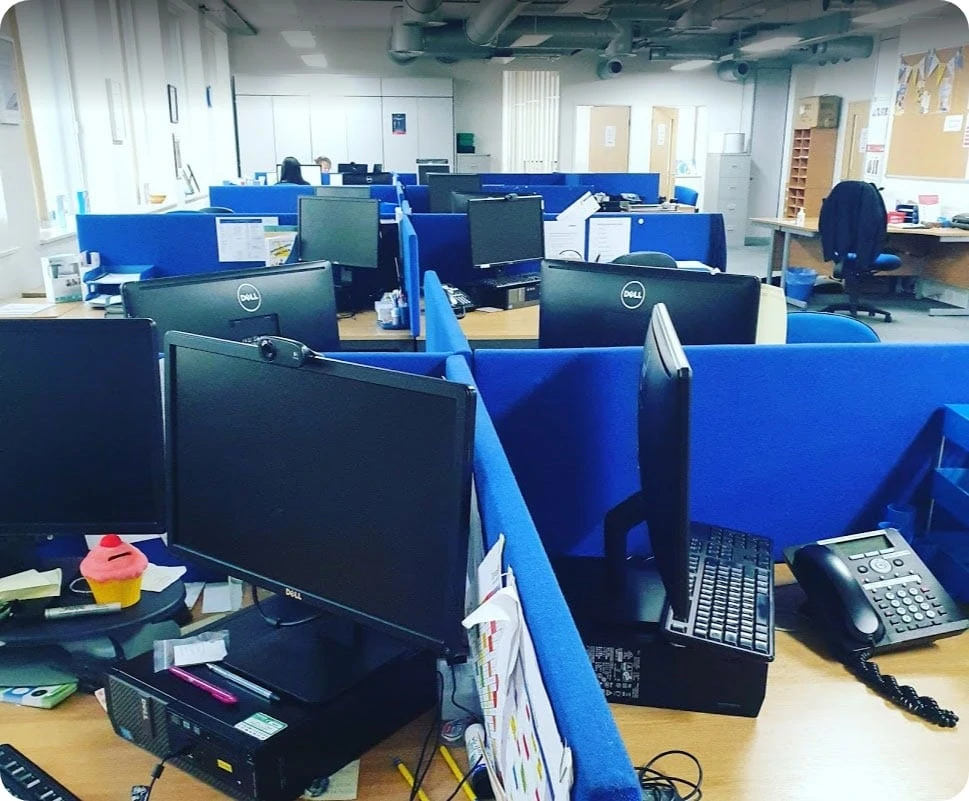
Electrical appliances such as laptops, kettles and vacuum cleaners are in regular use in offices, workshops, retail environments, hotels, restaurants, schools and factories.
One issue with portable appliances is that they are frequently moved, connected and disconnected every day and used continually. Through regular use, this can lead to wear and damage. Wires can become damaged, connections may loosen, insulation may deteriorate, and the appliance can become hazardous.
PAT testing helps identify issues that may develop in electrical appliances before they develop into a dangerous condition. Each PAT test includes visual checks, electrical testing and identification of potential faults, helping to identify issues at an early stage and reduce further deterioration that could result in fire, electrical hazards or equipment failure.
Carrying out Regular PAT Tests will enable Employers to:
- Ensure a safe working place for employees, customers, and visitors.
- Enable employers to fulfill their statutory duties.
- Minimise downtime through removing faulty items.
- Support valid insurance cover.
- A safe work environment for everyone.
In addition, PAT testing can assist with meeting insurance requirements. Many insurers require evidence of periodic PAT testing of portable electrical equipment where insurance claims arise for damage and loss resulting from electrical faults.
Portable appliance testing is vital for meeting regulatory obligations and insurance requirements, and helps with workplace risk assessments. Routine PAT testing can also support lower insurance costs for organisations.
For most businesses, PAT testing is a important part of a effective risk assessment and electrical safety management system.
What Equipment Requires PAT Testing?
The majority of businesses use a wide range of portable electrical appliances that should undergo PAT testing, including:
- Office equipment such as computers, monitors, printers, and photocopiers
- Extension leads and power strips
- Power tools and 110v equipment used on construction sites
- Kitchen appliances including kettles, microwaves, fridges, and freezers
- Battery chargers
- Vending machines and specialised equipment
- Emergency lighting and portable lighting systems
- DJ equipment such as mixers and speakers
If your organisation uses plug-in electrical appliances, PAT testing is generally required at regular intervals.
PAT Testing Legal Responsibilities and Requirements
In accordance with the Electricity at Work Regulations 1989 employers ensure electrical equipment in a safe working condition. Portable appliance testing is widely recognised as a commonly used method of showing compliance.
Employers also have a duty under the Health and Safety at Work Act 1974 to provide a safe working environment, and under the Provision and Use of Work Equipment Regulations 1998 to ensure all work equipment is appropriate and safe to use for its intended purpose.
PAT testing is an recognised way of showing compliance with national legislation and is carried out in accordance with UK law.
Employers can show compliance to insurers and regulatory bodies by maintaining proper documentation, including PAT testing certificates, test results and inspection records.
How Often Should Portable Appliance Testing Be Carried Out?
The interval of PAT testing should generally be determined by a risk assessment. Important factors include the working environment, type of equipment, and how often electrical appliances are handled or relocated.
Typical guidance includes:
- Construction tools and power tools: every 3–6 months
- Industrial equipment: annual PAT test
- Office equipment: annually
Regular testing ensures ongoing electrical safety and helps reduce electrical accidents.
OUR PAT TESTING PROCESS
To help you understand what we do, we have outlined our process below:
Visual Examination
Before testing an appliance we carry-out a visual examination to identify if there are any obvious problems such as damaged plugs, loose connections, overheated components etc.
Electrical Testing
The appliance will then undergo PAT testing using specialist PAT testing equipment that tests for Earth Continuity, Insulation Resistance and Polarity.
Labelling and Test Date Documentation
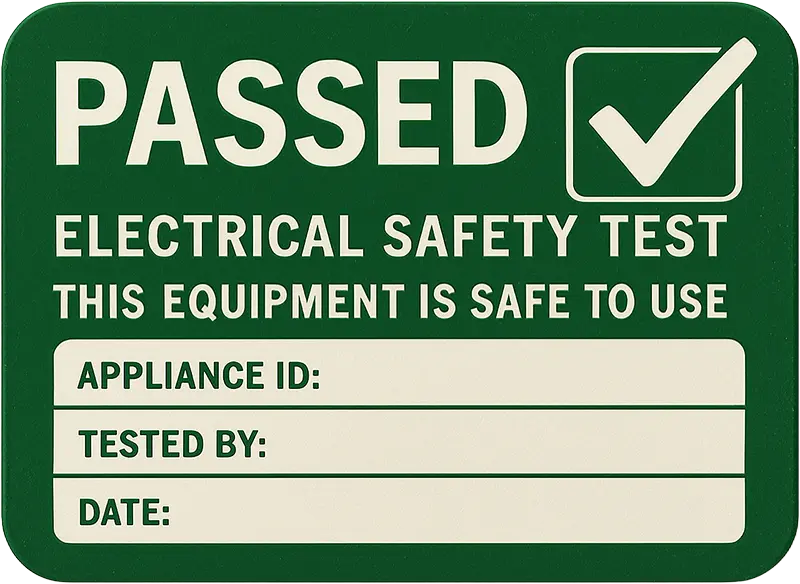
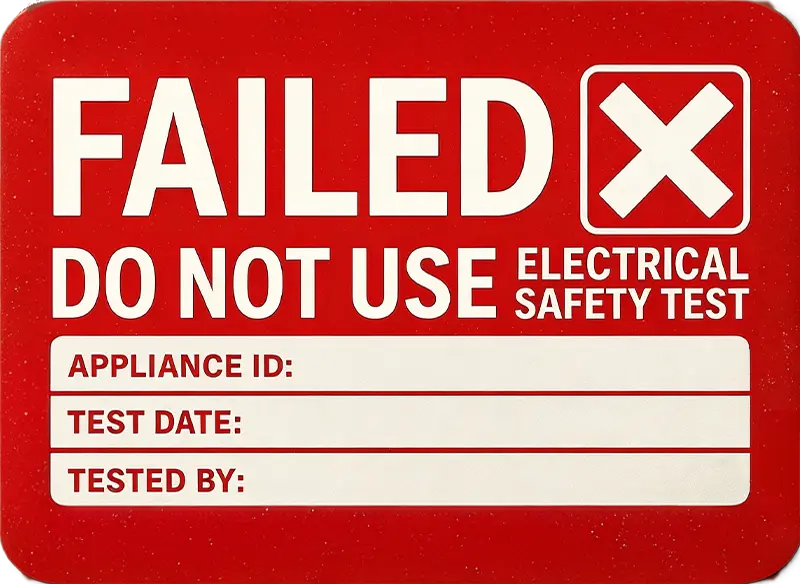
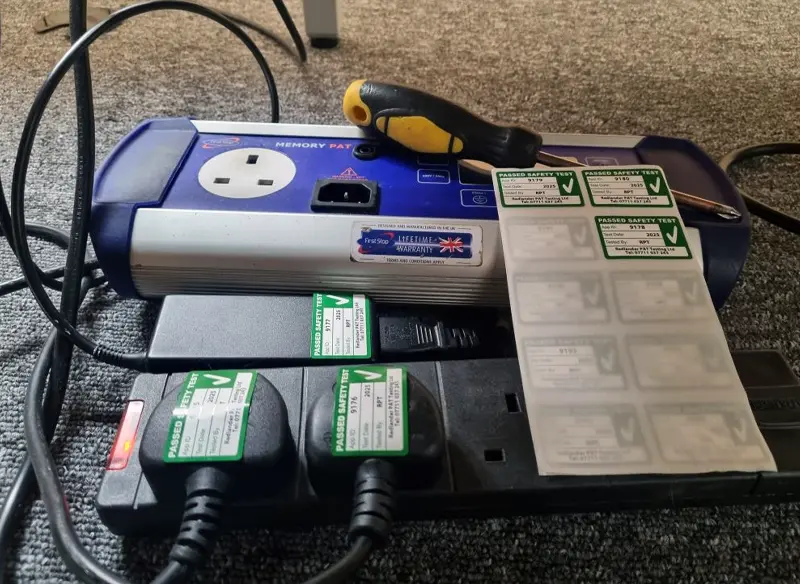
Once the appliance has been tested, it is labelled with the test results (pass/fail) along with the date the appliance was tested, so that future tests can be logged against this date.
Report and Certification
Your report includes:
Included in your report
-
✓
Full list of all electrical appliances tested.
-
✓
Pass/Fail result for each appliance.
-
✓
Certification for your Compliance Records. (e.g. Insurance and Audit purposes).
Frequently Asked Questions
Clear answers to common questions about PAT testing, compliance, and recommended retesting intervals.
How often should PAT testing be carried out? +
A business should complete a risk assessment to determine appropriate PAT testing intervals. Retesting frequency depends on the appliance type, how it’s used, and the environment it operates in.
Typical examples:
- Office equipment (computers, monitors, printers, kettles) is typically PAT tested annually.
- Construction site equipment (power tools, generators and 110V equipment) typically needs testing every 3 to 6 months.
- Higher-risk environments usually require more frequent testing than lower-risk environments (such as offices and hotel rooms).
Is PAT testing a legal requirement in the UK? +
PAT testing itself is not a legal requirement. However, the Electricity at Work Regulations 1989 require employers and other duty-holders to maintain electrical equipment and keep it safe, preventing danger.
PAT testing is widely used as a practical way to help demonstrate compliance with:
- The Electricity at Work Regulations 1989
- The Health and Safety at Work Act 1974
- The Provision and Use of Work Equipment Regulations 1998
In 2026, PAT testing in Birmingham remains subject to the same national laws and regulations that apply across the UK. It is governed nationally, not by local by-laws.
Why is PAT testing important for compliance and insurance? +
Regular PAT testing helps demonstrate electrical safety management and supports insurance requirements. Insurers may request evidence of routine PAT testing when handling claims linked to faulty electrical items.
Regular PAT testing helps:
- Maintain a safe working environment
- Reduce the risk of electrical accidents and faults
- Support risk assessments and ongoing maintenance plans
- Support insurance compliance and improve claim defensibility
- Contribute to improved safety management (which may support lower premiums)
What types of equipment require PAT testing? +
Any electrical appliance with a plug intended to connect to a wall socket or generator should be included in a PAT testing programme.
Common examples include:
- Office equipment – computers, monitors, printers, photocopiers
- Kitchen appliances – kettles, fridges, freezers
- Battery chargers
- DJ equipment – mixers, speakers, lighting
- Vending machines
- Power tools and 110V construction site equipment
Why shouldn’t you skip PAT testing? +
PAT testing is a proactive way to reduce risk and protect people and property. Identifying potential issues earlier helps ensure timely maintenance and safer ongoing operation.
Regular PAT testing reduces the chance of:
- Electrical accidents
- Fire caused by faulty electrical items
- Legal consequences from non-compliance
- Invalid or challenged insurance claims
- Business interruption and reputational damage
- Accidents and injuries caused by faulty equipment
What types of businesses do you provide PAT testing services for? +
We provide PAT testing for a wide range of organisations, including:
- Offices and commercial buildings
- Retail and hospitality venues
- Industrial and workshop environments
- Educational facilities and schools
- Landlords supplying electrical appliances
Do schools and factories need PAT testing? +
Yes. Schools should PAT test electrical equipment to help maintain a safe environment for students, teachers, and staff. Factories should also regularly PAT test portable and fixed electrical appliances to support compliance and reduce the risk of injury.
Examples of factory equipment often included:
- Fridges and freezers
- Portable tools such as electric drills
- Chargers, extension leads, and portable equipment
How does risk assessment affect PAT testing frequency? +
A risk assessment classifies appliances into different levels of risk and helps determine suitable retesting intervals. Frequency depends on the appliance type, its usage, and the working environment.
- Low-risk examples – office computers and similar equipment, typically PAT tested annually (often for insurance records), and also after being moved or installed.
- High-risk examples – construction tools and site equipment, usually requiring more frequent testing (often every 3 to 6 months).
Is 110V construction equipment included in PAT testing? +
Yes. 110V equipment used on building and construction sites should be included in PAT testing. Although it operates at a lower voltage than standard 230V equipment, it is often used in higher-risk environments and still requires testing to verify safe operation.
How is PAT testing priced? +
PAT testing pricing is typically tailored to the site and the amount of equipment being tested. Many providers use a structure that includes a call-out fee (covering the first set number of appliances), then an additional charge per appliance after that.
In most cases, the more items tested, the lower the per-appliance cost becomes. This approach helps organisations with larger equipment lists achieve better value for money.
Who should carry out PAT testing? +
PAT testing should be carried out by a competent and qualified tester with the appropriate knowledge, training, and experience to perform accurate testing and provide reliable documentation.
Choosing a professional provider helps ensure thorough inspection, accurate results, detailed reporting, and minimal disruption while testing is carried out.
Why use our PAT testing services in Birmingham? +
Using a professional PAT testing service provides a complete process – visual inspection, electrical testing, and clear documentation – followed by detailed reporting and certification for your compliance and insurance records.
We support businesses, schools, landlords, and organisations across Birmingham and the surrounding areas, helping you maintain safe electrical equipment and demonstrate effective safety management.
AVAILABLE THROUGHOUT Coventry
Not in Coventry? No problem, our services are available throughout: the West Midlands.
- Allesley
- Ball Hill
- Binley
- Canley
- Cheylesmore
- Coundon
- Earlsdon
- Finham
- Foleshill
- Hillfields
- Holbrooks
- Keresley
- Radford
- Stoke
- Styvechale
- Tile Hill
- Walsgrave
- Whitley
- Willenhall
- Wood End
- Wyken

GET IN TOUCH
Fill in the form below
Testimonials
What our customers are saying
Charlotte Bennett
Two months ago
Bindiya Turtle
One month ago
Richard Overton
Three months ago
SOME OF OUR CLIENTS